Category Archives: Uncategorized

Inspiring Leaders Know to Choose Their Words Carefully

Inspiring Leaders Know to Choose Their Words Carefully“I would like to take a moment and make something clear to everyone. I do not expect, nor do I want, any of you to miss or sacrifice important family obligations for work… In fact, I will go so far as to say that if I find out that you are working with me while missing important family responsibilities, it will disappoint me greatly.”

These excerpts are from a 2014 internal memo (recently gone viral) Vice President Joe Biden sent to his team members.

The language he chose is precise and particular. Biden warmed the heart by addressing the note to “My Wonderful Staff,” and signed off with a sincere “Thank you for all the hard work.” He stressed how important it is that his valued employees maintain a healthy work-life balance. And he owned this directive, by clearly stating how personally disappointed he will be to learn after the fact that an employee has missed a crucial family moment because of work.

Related: Your Words Have Impact, So Think Before You Speak

He also included a very detailed list of what he considers “family obligations,” including birthdays, religious celebrations and graduations. This information was so valuable to his team — since most of us, especially when we’re swamped, will “grade” family obligations on a sliding scale from “critical” to “OMG I simply can’t take a day of just for that!”

Why language matters.

We know that spending too much time at work (or working at home) can lead to unhealthy and unproductive teams. But do we understand the impact of language? Poor choices of words, especially coming from company leaders, can affect employee morale, productivity and health.

Let’s take a look at a couple of scenarios, from the employee’s perspective, where poor word choices can have powerful effects:

Scenario 1: Heading into an important meeting you’ve spent weeks preparing for, your manager turns to you and says, “Let me do the talking. You can take notes.”

Result: You immediately feel demoralized. It’s clear your manager doesn’t fully trust you, and in turn, you begin to doubt yourself.

Scenario 2: Your boss is annoyed because there was a simple error in one of your monthly reports. Mistakes happen. But, your boss expects perfection. “Why can’t you be more like Tony?” he says, “He would never allow something like this to slip through the cracks.”

Result: Aside from feeling hurt by this overreaction, your boss has now turned the tables on poor Tony as well. You are envious of him and resent the implication that he’s better than you. Your boss has created team divisions and you no longer work as well together.

Related: 4 Communications Missteps Lethal for Your Career

Scenario 3: Work has been extremely stressful and you’re having issues with a coworker. You talk to your manager about it, hoping for a resolution. Instead, he trots out the old line “You know, with the economy the way it is, you should feel lucky to have a job. Try harder to work it out on your own.”

Result: When a manager doesn’t offer help and reminds you that you should be grateful to have a job, it essentially tells you that you’re not worthy. Communications like this erode corporate loyalty and build resentment.

Turn the negatives to positives.

Words can hurt. But leaders can use positive language to create an environment of trust, a place where employees feel safe and valued. Here are some tips to help you turn negatives into positives:

Be attentive and respectful. Be present when an employee requests a one-on-one with you. Don’t check email or text. Actively listen to what they’re saying and if you don’t agree with them, keep your emotions in check. Suggest a follow-up discussion and craft your response in a way that benefits you both.

No matter how stressed you are, don’t explode over every mistake. Your employees aren’t robots. Unless these errors are a running trend, mention it, but resist using language that will humiliate or make your teams fearful. If you don’t, you’ll end up with a resentful workforce without the self-confidence to help your organization grow.

Use positive language even in a negative situation. Have a less than stellar team member? Let them know that their behavior is unacceptable, but don’t take this opportunity to belittle and berate them. Be firm, but respectful. Instead of focusing on the negatives, highlight good things they do bring to the table. Never use insults, and allow them some time to have the floor to explain.

Related: When Negotiating, Choose Your Words Very, Very Carefully

Vice President Biden’s memo made his team feel valued, trusted, and secure. By choosing your words carefully and bringing out the best in your teams, you will have a happy, healthy, loyal and productive workforce.

Meghan M.Biro

Ending a Prospecting Call

business-womanAs difficult as it can be to get someone on the telephone, knowing what to do after the call can be just as difficult. Below are things to remember when you’re ending the initial prospecting telephone call.

In my new book coming out soon, I discuss this issue and every other critical issue, with the goal to provide you with the tools to be successful.

High-Profit Prospecting: Powerful Strategies to Find the Best Leads and Drive Breakthrough Sales Results

  1. Repeat back to the prospect one thing you learned from them, as a way to confirm you’ve been listening.
  1. Just before closing the call, ask them one more question regarding something they’ve shared with you. Doing this demonstrates you value their opinion and will many times compel the prospect to share with you even more valuable information.
  1. Thank the other person, ending the call in the same classy manner as you began the call.
  1. Gain a commitment as to the purpose for the next call. Typically this will be based on the key information you learned from them.
  1. Gain a commitment for a time for the next call.
  1. Regardless of what the customer might ask you to send to them in an email, resist the temptation. The most common reason the customer is asking you to email them is as a way to get you off the phone. If asked to do this, state how there is simply too much information you could send them and it wouldn’t be make any sense without knowing more specifically about their needs.
  1. Do not email to the prospect after the call enough information to allow them to make a decision without talking with you. It is appropriate to email them information and ask for their opinion, but keep it short and tight, so to not overwhelm the prospect.
  1. The purpose of the call is to earn the right, privilege, honor and respect to talk with that person again. Regardless of how they might treat you, never lose your respect and dignity.
  1. View each call made as another step in the journey that will move you one step closer to qualifying the prospect as someone you expect to turn into a profitable customer.
  1. Enter all of the information you learned from the customer and what you shared into your CRM system.

Keep reading my blog and over the coming weeks, as I’ll be sharing a lot more information about prospecting. To get more prospecting tips and learn more about my book, go to High-Profit Prospecting.

Copyright 2016, Mark Hunter “The Sales Hunter.” Sales Motivation Blog. Mark Hunter is the author of High-Profit Selling: Win the Sale Without Compromising on Price and High-Profit Prospecting: Powerful Strategies to Find the Best Leads and Drive Breakthrough Sales Results.

Mark Hunter

The Only 3 Things to Do (Over and Over) to Make Your Brand Stand Out

The Only 3 Things to Do (Over and Over) to Make Your Brand Stand Out

Customers want more than an experience. They want emotion.

Customers want a brand that they feel they need in their lives, according to the “The Brand Gap” by Marty Neumeier. The definition of a “brand is a person’s gut feeling about a product, service or company,” Neumeier writes.

According to Neumeier’s definition, all that digital marketers have to do is connect to customers on an emotional level and brand presence will grow — or continue to grow.

Easy, right? Well, not so fast.

First, consumers’ needs and wants are constantly changing, so businesses must keep up with change to keep up with the competition. You have to stand out.

Building your brand — into a business that customers will feel emotional toward — starts with being more present and engaging online.

Why is building your brand online important? ‘They expect businesses to earn their dollars’

Consumers will interact with your brand online and offline. Make sure your brand message is clear and that you are exceeding customer experience expectations in both the online and offline world.

Related: 6 Secrets Nobody Tells You About Personal Branding

To create a brand message, combine your business’s values with what your customers want, and where you want to position yourself in the marketplace.

“Buying just about anything, whether it’s a $20 shirt or a $20,000 car, is more of an emotional act for them, [consumers], than ever before. They expect businesses to earn their dollars; they won’t just hand them over.” That’s according to the June 2014 State of the American Consumer Report by research and consulting company Gallup.

When a business does exceed customer’s expectations, 23 percent of the customers who are fully engaged “represent an average 23 percent premium in terms of share of wallet, profitability, revenue, and relationship growth over the average customer,” according to Gallup.

A large part of customer engagement comes with defining a strong brand promise and delivering on that promise. You define the brand promise based on the customer: the customer defines your brand. Without customer feedback, you can’t define a brand promise.

“A brand promise tells the world what a company stands for, what makes its products or services different from the competition’s, and why it is worthy of being chosen by customers,” according to Gallup.
1. Connect to your customers.

An online review is content for your brand. This means they play a role in how Google ranks search results. Customers have a better chance of finding your business when there are information-filled online reviews to read.

Related: The 7 Stages Of Branding

And that information is full of customer insights. There’s a method you should use to understand how customers feel about your business: sentiment analysis. What are the trends you see? What are customers saying about your brand? These questions can be answered with a sentiment analysis tool.

Increase your presence on online review sites and social media.
2. Be consistent.

Your organization should be consistent in everything including brand voice. Consistency in your brand voice will turn purchasers into loyal, committed customers, while inconsistent messages will just confuse your customers.

One of the methods you should use to help you create your brand voice is sentiment analysis. This tool will help you understand how customers feel toward your business, which will help you hone in your brand messaging, and in which direction you should take your brand’s voice.

Let’s take a look at Coca-Cola as an example of a successful brand. Yes, there have already been authors of blog articles who reference Coca-Cola — as they should — it’s one of the greatest brands of all time. The beverage company is a good example of consistency across its entire organization: emotional appeal, social responsibility, products and services, its performance financially, workplace environment, and vision and leadership, according to Rich Duprey at the Motley Fool. That consistency is one of the reasons the historic company has been successful.

Another reason? “By forever investing in its brand in ways that matter to consumers,” Duprey writes.
3. Create content for a blog.

A blog is a great way to establish your business as a thought leader in your industry. Write a blog for your website and get customers to find your business with meaningful and useful content.

Related: The 7 Tenets of Branding

Don’t know what to write? Ask yourself what questions your customers ask and answer them in a public-facing blog post, or conduct keyword research and create content based on the most popular search keywords related to your business.

Make sure your business has a strategy to connect with customers on an emotional level, consistently.

Chris Campbell

10 logos that make clever use of negative space

These great examples of negative space in logo design show how to do it right.

The human brain is a wonderful device. When there’s something missing in a scene, it tries to fill in what’s not there and make sense of it. And if you’re clever, that’s something you can exploit as a designer.

When used right, negative space – the space around and between the subject of an image – can be a wonderful tool in grabbing attention and getting people to form a stronger psychological connection with your design. By making the absence of something as important as the object itself, negative space helps to bring balance to a composition in a way that can be delightful to look at, and get people to take a second, and third look too.

Here we’ve picked 10 great examples of negative space in logo design. Have you spotted any more out in the wild? Let us know!

01. Landfit

The concept of unused spaces dovetails beautifully with negative space in this logo design for Landfit

Landfit was a scheme launched in the London Borough of Lewisham to match keen horticulturalists who had no garden of their own with people who had gardens but no time to tend them. They commissioned Designed by Good People to brand this metaphorically and literally groundbreaking project. The agency reasoned: “If it’s about getting people to use unused spaces, why not grow vegetables in the unused spaces in the logo?”.

02. MyFonts

You have to hand it to the designers: this logo for MyFonts makes superb use of negative space

One of the most popular ways of using double space in logos is to provoke the viewer to do a double take, by creating alternative ways of perceiving an image. And here’s a great example. In 2009 the world’s largest reseller of fonts, MyFonts, completely redesigned their corporate identity, and graphic designer Nick Sherman commissioned Dutch agency Underware to develop a new logotype.

To Underware, MyFonts represented not just a collection of fonts, but a place where the creative spirit thrives. Borne from this notion came a creatively conceptual logo, which has two possible visual interpretations. (Not spotted it yet? The M’s a hand.)

03. Guild of Food Writers

A complex idea is conveyed with stunning simplicity in this negative space logo

Sadly no longer with us, the consultancy 300 Million won a D&AD Award for their logo for The Guild of Food Writers, an organisation dedicated to excellence in food writing and culinary education that counts Hugh Fearnley-Whittingstall and Nigella Lawson among its members.

Combining a pen nib and a spoon to convey the purpose of the Guild, it uses negative space to make its point with brilliant visual efficiency.

04. ED (Elettro Domestici)

This logo design for an electricity company will make you do a double take

Italian graphic designer Gianni Bortolotti created this wonderfully minimalist logo design for the company ED (Elettro Domestici), combining its two initials side by side to form the shape of an electric plug. Whilst witty lateral thinking can be overdone in logo design, this is great example of how form and function can coexist harmoniously; whether your brain first registers the letters or the plug, the meaning is clear.

05. NBC

This classic logo preserves NBC’s peacock in the space between

TV network NBC has featured a peacock in its logo since 1956, when it was introduced to highlight the network’s colour programming. With a series of redesigns over the years, that bird has gradually faded into the background as the logo has become more streamlined. Created in 1986 by Steff Geissbuhler while at Chermayeff & Geismar, this version (with a few tweaks) has lasted until the present day. By subtly including the bird in negative space, this design gives a modern, streamlined feel to the logo while paying tribute to its impressive heritage.

06. Mister Cooper

johnson banks created a sexy and sophisticated look for Mr Cooper by combining positive and negative space

How do you brand an ice cream aimed specifically at adults? Briefed to design a distinctive logo for alcoholic ice cream startup Mr Cooper, johnson banks made sophisticated use of positive and negative space to develop this eye-catching logo.

Playing with different approaches, the agency settled on the idea of a typographic lipstick mark, senior designer Kath Tudball explains. “This concept really suited our client, expressing the hedonistic nature of the product in an appropriate form. The logo could be rubber stamped directly onto white paper cups and napkins as if a cheeky kiss had recently been planted.” Find out more about how the design was created here.

07. WWF

This adorable panda has become emblematic of the conservation movement as a whole

Sometimes negative space is so cleverly done, you don’t even know it’s negative space. This logo for the WWF (World Wildlife Fund) makes clever use of negative space to create the form of the panda’s head and back.

The original WWF panda, drawn in 1961 by co-founder Sir Peter Scott, was based on Chi-Chi: a giant panda that had arrived at the London Zoo that year. The negative space version was created in 1986 at the San Francisco office of Landor, and it’s since become emblematic not just of the WWF but the conservation movement as a whole. You can see Pentagram partner Angus Hyland talking about the WWF logo (and Penguin’s) in this video.

08. Le Mans

Numbers never looked cooler than in this negative space logo for Le Mans

This visual identity for the world-famous Le Mans sports car race was created up by sport-oriented design agency Leroy Tremblot. While it attracted some criticism from fans for being ‘cold’ and not incorporating a sense of the race’s heritage (it’s been running since 1923), we can all agree the use of negative space to combine the ‘2’ and the ‘4’ is brilliantly executed.

09. Toblerone

Follow the bear in this classic logo design for Toblerone chocolate

The Toblerone chocolate company hails from Bern, Switzerland, which is known for high mountain, and Bern is also called “The City Of Bears”. That’s a lot of imagery to get into one simple emblem. But by hiding the silhouette of a bear in the mountain illustration, this classic logo design neatly portrays the heritage of the brand, in a colour that makes you think of the chocolate too.

10. FedEx Logo

The FedEx logo uses negative space to convey the forward-looking nature of the company

The granddaddy of negative space logos, this iconic logo was designed by Lindon Leader while at Landor (try saying that when you’re tipsy). The designer cleverly manipulated Univers 67 (Bold Condensed) and Futura Bold letterforms to create a white arrow between the E and the X. The use of negative space in this logo, which has won numerous design awards, perfectly portrays the notion of a ‘forward moving company’, in both senses of the word.

Tom May

7 Creative Strategies for Marketing

7 Creative Strategies for Marketing Your Startup on a Tight Budget

Bootstrapping builds character. There are endless ways to finance your ideas, but there’s nothing like marketing a startup with a modest budget to encourage innovation. Limited funds give you an excuse to flex your creative muscle and truly share your vision with the world.

Don’t rely on the same old banner ads and Google reviews. Instead, try these eight marketing strategies to place the spotlight on your business.
1. Share your central “why.”

“What do you do for a living?” This simple question is one you’re asked during almost every introduction. If you answer with a quick, “I’m an entrepreneur” (vague and a little diluted) or, “I run a small business” (makes people think of brick-and-mortar spots), you’re cheating yourself out of an opportunity to generate word-of-mouth marketing for your business.

Instead, develop a narrative that differentiates your company from others and sparks conversation. Does your startup support a certain cause with every sale? Say so. Did you come up with your business idea during a troubling life event? Mentioning it may inspire those around you.

Related: Social Media Marketing Tips for Local Businesses

Sharing your central “why,” as well as the story on how your startup came to be, will make your business more memorable to others. Plus, it will interest people more at parties.
2. Don’t just sell — engage.

As an entrepreneur, your instinct may push you to sell to everyone you meet. Though there’s nothing wrong with flaunting your brand now and then, it’s important to give your company relevance and participate in discussions that don’t quite revolve around your business.

With social media, it’s easy to engage your target demographic without looking like you’re just trying to advertise. Some businesses may leave encouraging comments on photos of people’s food; sports equipment retailers may “re-post” articles on a local high school basketball team’s recent win. Build brand trust by showing your support, whether of your community or your online following.

Next time someone’s looking for a product or service within your niche, they’ll remember your kindness and go to you. Sharing someone else’s content doesn’t necessarily mean losing your audience’s attention. You can use Start a Fire to create share-ready URLs that add branded badges to any Web page, so that when someone clicks on the links you post, they’ll see you there, along with more content that you recommend.
3. Carve a niche and build industry credibility.

Your startup’s shoestring budget can’t keep you from carving out its own niche. Assemble a culture around your business by offering an insider’s perspective to those on the outside. A blog can offer laymen the chance to understand your trade with a new perspective. A webinar or a podcast can help viewers (or listeners) feel like experts in your field. Speaking at an incubator, expo or niche event can put you in the role of the teacher and allow you to share your groundbreaking ideas with an immediate audience. The small business convention you attend every year is probably in need of a few more keynoters; why don’t you try speaking instead of observing?

Networking and sharing your expertise with others can help you prove your abilities to your community. A variety of people, from journalists to aspiring entrepreneurs, can help to create buzz around your business.

Try offering your expertise to small business newbies through forum sites like Quora, where thousands of aspiring entrepreneurs ask questions for pros to answer. You can also share your story by connecting with journalists online via Help a Reporter Out (HARO).
4. Help people discover your content.

If your startup is fit for the twenty-first century, it maintains some sort of online presence. In fact, you may be satisfied with just a website, some social media pages, a blog, or even a simple web page. Just because your content is online, though, doesn’t mean it’s easily found by your target audience.

With every post you publish, use keywords specific to your niche, like “vegan leather tote” instead of “handbag,” for example, to improve your Google rankings. You can also use these hyper-targeted keywords to power your social media-based audience acquisition. With Socedo, a social media automation tool, you can find Twitter users who post content using your niche keywords and engage with them over time.

Related: Small Business Marketing Tips for 6 Industries

Next, help people find your content by practicing a few SEO techniques, starting with your website. Title your pages with phrases unique to your business so they stand apart from other sites. Improve your website’s load speed by removing unnecessary plug-ins and long strings of code (perhaps a job for your Web developer), and always be sure to post original content instead of copying from another site. There are countless options for improving your general SEO ranking, but taking care of a few easy tasks will boost your content’s position in search results for now.
5. Send out irresistible e-coupons.

You’ve probably experienced coupon temptation before. Research shows that very few can resist the appeal of a great coupon; four out of five consumers use coupons regularly both in-store and online. Moreover, about half do business with a particular company because they were provided a coupon.

While you could go the old-fashioned route and distribute coupons via snail mail, exclusive e-coupons hit two birds with one stone by convincing more people to join your email list. There are also some clever ways to integrate e-coupons into your email marketing strategy.

Those who are already invested in your mission will appreciate the ways in which you thank them for their business. People new to your company will be more likely to join your following. It’s a win-win.
6. Scratch their back, they’ll scratch yours.

If you’re just starting out, you may have a hard time introducing your company to the public. A great way to build a niche and generate word-of-mouth is through samples and giveaways.

Try reaching out to eager members of your target audience and offering up your commodity (or a sample slice of it) in return for a review and shares on social media.

Related: 10 Marketing Tricks From the Pros

Those who participate get a cool new item or experience to share with their friends, while you get trust and visibility — another win-win. You don’t want to give up your entire stock all at once, but sharing it with a select few could give you a marketing edge.
7. Co-sponsor an event within your niche.

Every industry hosts its special events: the annual Carnegie Conference for traditional and digital marketers, Veritage Miami for U.S. winemakers and the Interior Design Hall of Fame gala for — you guessed it — interior designers. Unless an event is owned and managed by a single company, most planners seek out sponsors to help fund the event.

This provides you with a fantastic niche marketing opportunity. Next time you’re thinking about attending an event within your industry, see if it has any sponsorship spots open. Better yet, ask whether you can present there (or otherwise spotlight your company) to further engage attendees. Aside from giving you a good name, co-sponsoring a niche event allows you to meet and greet with your target demographic, network and generate new leads.

Your modest marketing budget doesn’t have to stop you from showcasing your startup. Leveraging connections, special events, skills and the Web can give your business a special twist. What creative marketing strategies have you used to spotlight your startup?

Matthew Toren

Donald Trump’s Top 10 Ways to Think Like a Billionaire

Whether it is success in sport, business, or art- successful people always live by the same rules. People always find success the same way, and Donald Trump gives you the tools and rules to live by.

Before we get into Donald’s rules, you need to know this one certainty: Getting rich requires a mindset shift.

To think big and get rich you must follow the rules of the successful – even if you don’t like them! Normal people want a step-by-step guide to getting wealthy and they scoff when their wealth guides don’t include concrete steps from A to Z. No one’s going to sell you a get-rich-quick scheme that actually works. Plans that work are always kept in secret. You think Colonel Sanders is just going to give you his famous chicken recipe? Get real. You have to make your own recipe for success.

The key to understanding the path to success is to understand that it is a MINDSET, it isn’t an instruction manual like you get from from Ikea. The real step-by-step guides to wealth focus on mindset not on actions. None of the rules of success work unless you do the work! That’s why the truly successful try to teach you about mindset rather than by giving you concrete rules to follow. If you give a man a fish he eats for a day, if you teach a man to fish he eats for a lifetime.

When you can understand the mindset without becoming emotional, that’s when you can unlock the key to wealth.

When you fish for success your mindset is the bait that attracts success. After you develop the mindset, everything else falls into place. With the wrong mindset, nothing works. With the right mindset, everything works. The actual steps you take to success are irrelevant. It’s the mindset, the stone-cold belief, that brings you to new heights. Adopt the mindset, take the daily steps and there you are.

Successful people think differently than normal people. “Successful people” thoughts are much colder and bolder than “normal people” thoughts. The rules of the rich always seem counter-intuitive to normal people but that’s because normal people were taught the normal rules by normal people. Rich people play by different rules and don’t give a damn if you like it or not. That’s what you have to learn how to do – think rich without remorse.

If you want to get rich you must start thinking (and acting) like a successful person.

When normal people hear the thoughts of the successful they start to act like children. They hear the truth and get uncomfortable, then they shrink and say “that’s bad” like little infant babies. Boo-hoo, too bad, cry more and then get over it. You must stop complaining that thoughts are bad. Success is as it is – not as you wish it to be.

You must realize that rich and successful people think this way for a reason. It is infinitely better to be bold than it is to be meek. If something works, it works. You need not be emotional about it. Instead, be curious, reverse-engineer the plan, emulate it and apply it to your own life and business. If you waste your brainpower being sad that these traits are “bad” then you won’t get anywhere.  But if you’re ready to learn to earn from the master of the MAGA mindset, here you go…

Donald Trump’s Top 10 Ways To Think Like The Rich

#1) Don’t take vacations.

“What’s the point? If you’re not enjoying your work, you’re in the wrong job. Even when I’m playing golf, I’m doing business. I never stop, and I’m usually having fun.” – Donald Trump

What business is Donald Trump in? He’s in the Donald Trump business. He isn’t in the real estate business or the publishing business – he’s in the Donald Trump business and his business stays open 24/7.

To get big success, always be “on” like Jerry Seinfeld. Your mind has to constantly be on work. Your mindset and actions are literally what make the business. Your work becomes you as business and life become intertwined. There is no “business/life balance” for highly successful people. The truly successful people ARE the business.

It isn’t possible to truly take a break when you’re business is your life 24/7. You can take a break from the office but you can’t take a break from being you. A king never stops being a king! Even if he’s on an island with a bunch of beautiful babes in bikinis – he’s still the king. He still has responsibilities and business on his mind and it won’t ever go away unless he quits, fails or retires.

When your mind is always on work it is impossible to relax on some beach somewhere. Even if you take a physical vacation, you’ll never have a mental vacation. That’s if you actually even wanted a vacation. When you have passion for your work, vacations are the worst thing in the world.

When you have a burning passion for what you do, you are the most relaxed while working. When big business is on your mind, working is relaxing and vacations are stressful. Take a vacation while your building a million dollar business? Don’t make me laugh. Business first, forever and ever and never to stop until you die or quit.

#2) Have a short attention span.

“Most successful people have very short attention spans. It has a lot to do with imagination. Quite often, I’ll be talking to someone and I’ll know what they’re going to say before they say it. After the first three words are out of their mouth, I can tell what the next forty are going to be, so I try to pick up the pace and move it along. You can get more done faster that way.” -Donald Trump

Be ahead of the game. When you’re ahead of the game, your attention span will be cut short because it won’t have another option. You’ll be living in the future (because you’re the visionary) and the people around you are all stuck in the past. When they speak we’ve heard it all before and we already know what they’re going to say.

People often want to explain to you in detail and it becomes tedious because you already know the details. “Come on and get to the point” becomes your every day reaction to people who are too slow to get to the point. It would be like explaining remedial math to an engineer – the engineer already knows basic math and he’s moved past it.

You don’t have to be a mega-genius to get rich, but you do have to be pro-active and ahead of he game. When people are talking to you you’re in a state of reaction and they’re behind the game. No need to suffer through their words, just cut them off and move on. Ain’t nobody got time for slow people.

#3) Don’t sleep any more than you have to.

“I usually sleep about four hours per night. I’m in bed by 1am and up to read the newspapers at 5am. That’s all I need and it gives me a competitive edge. I have friends who are successful and sleep ten hours a night, and I ask them, “How can you compete against a people like me if I only sleep four hours?” It rarely can be done. No matter how brilliant you are, there’s not enough time in the day.” -Donald Trump

You have to work all the damn time to get ahead in a big way. Driven people hate sleep because it really gets in the way of work. If I could personally reduce or eliminate sleep I would. I’m not a jealous man but you can bet I’m envious of this next secret.

Here’s a real secret of big success (that you can’t do anything about): Many highly successful people do not require much sleep to function. They’re called short-sleepers and they only need 2-4 hours of sleep per night to function at a high level.

Natural “short sleepers,” as they’re officially known, are night owls and early birds simultaneously. They typically turn in well after midnight, then get up just a few hours later and barrel through the day without needing to take naps or load up on caffeine.

They are also energetic, outgoing, optimistic and ambitious, according to the few researchers who have studied them. The pattern sometimes starts in childhood and often runs in families.

While it’s unclear if all short sleepers are high achievers, they do have more time in the day to do things, and keep finding more interesting things to do than sleep, often doing several things at once.

Not everyone can be a short-sleeper, but everyone can reduce your time spent sleeping. The experts say you need 8 hours of sleep, Arnold Schwarzenegger says you only need 6. Who you gonna believe? If you think you need 8 hours of sleep instead of 6, Arnold has some advice for you: Sleep faster.

#4) Don’t depend on technology.

“A lot of it is unnecessary and expensive. I don’t have a computer on my desk. I don’t use an intercom. When I want someone in my office, I yell. It works a lot better than an intercom, and it’s much faster. I don’t even have an ATM card…When I go to restaurants, I rarely have to pay. It’s usually on the house. The sad part is that if I needed the money, they would make me pay!” -Donald Trump

Technology doesn’t create the mindset. It’s the opposite, innovative mindset creates technology. All you need is the mindset, you don’t need gadgets and doo-dads to succeed.

I always talk about how I didn’t even have a smart-phone for a numbers of years while building my publishing business. A smart-phone would have been an enormous distraction to me at that time. Focus is key. Electronic distractions can be just that – distractions! When you’re working, turn off the phone, turn off the email, turn off the twitter and focus on work.

#5) Think of yourself as a one-man army.

“You’re not only the commander in chief, you’re the soldier as well. You must plan and execute your plan alone.” -Donald Trump

Your journey to success starts and ends with you. Other people will help you along the way but no one will do the work for you. Your mindset is the model of the business and without your mindset there is no business. There’s no Trump Tower without Donald Trump. Thousands of people helped to build the tower but only one man made Trump Tower possible.

YOU must be the innovator, YOU must be the risk-taker, YOU must be the visionary, YOU must be the leader. Everyone else is a follower, trying to play catch-up to your imagination. It’s you. It isn’t us and it isn’t we – it’s you! You’re a lone wolf in this game so get used to it. Read You, Inc. to learn how to start your one-man army.

#6) It’s often to your advantage to be underestimated.

“You never want people to think you’re a loser or a schlepper, but it’s not a good idea if they think you’re the smartest guy in the room, either. Because I wrote The Art of the Deal, everyone is always on guard whenever I negotiate with them. One of the reasons President Reagan was such a successful candidate  was because rival politicians consistently misjudged him. They assumed an actor wouldn’t be able to compete.

In How to Get Rich, I discussed how important it is to let people know about your accomplishments. I’ll always believe that but there are time when it’s even more impressive if people discover your accomplishments without you telling them directly.” -Donald Trump

It is often better to fly under the radar. When people expect huge (yuuuge) things from you and all you give them is big things, they will be disappointed. If people expect little from you and you deliver big they will be delighted.

Often, if people don’t expect much from you they will leave you alone to work in peace. If they expect too much from you, they’ll never leave you alone (and eventually you will blow up as an “overnight success” that no one expected or predicted). They’ll always be harassing you for results, stressing you out.

Everyone should know you are rich and smart, but not everyone need to know exactly how rich and smart you are. Everyone thinks they know and that’s the real fun, no one really knows but you.

#7) Success breeds success.

“The best way to impress people is through results. It’s easier for me to do deals now because I’ve had so many triumphs. You have to create success to impress people in the world of business. If you’re young and you haven’t had any successes yet, then you have to create the impression of success. It doesn’t matter whether the success is a small one or a big one-you have to start with something and build on it.” -Donald Trump

Grandiose_delusions_cat_lion.pdf

Wait a second here, “create the impression of success?” That sounds a lot like pretending! Too bad there is no way you could pretend yourself into success, right? Wrong. People can and do fake it ’til they make it. But there are two types of people who fake it ’til they make it:

  1. People who fake it
  2. People who fake it UNTIL they make it

See the difference? Some people who “fake it ’til they make it” forget the 2nd part, make it, and all they do is fake it. Those people are liars, fakers and con-artists. But then there is the 2nd type of people who fake it until they actually make it. These people were never fake at all, they simply saw what other people didn’t see. They were visionaries and they turned the vision in their heads into a reality. They saw their success clearly in their minds, they believed it, and that self-belief eventually became reality.

Before you “make it” they’ll call you fake and delusional. After you’ve made it they’ll call you a visionary with immense self-belief. Remember, it doesn’t matter what they call you at first, it only matters what you believe and achieve. No one was successful before they were successful. It has to start somewhere.

To become successful you have to believe you will become successful. Belief with nothing to show for it (yet) is cocky and brash but it’s better to be cocky and brash than it is to be meek and weak. No one ever got ahead with a meek mindset. Success takes a damn #MAGA Mindset! After you “make it” you’ll have the most beautiful thing in the world: MOMENTUM.

#8) Friends are good, but family is better.

“It’s better to trust your family than your friends.” -Donald Trump

“B-b-b-but I trusted you!” -Schmuck

The silly need to trust people is for children. When you grow up you always have someone you know you can trust – yourself. Trust in yourself and your vision and trust other people to be people. It is beyond silly place your trust another man’s value and integrity when all you need to trust is your own.

Friends are fun, but trust is a silly thing to give out. You never need to trust friends. You only need to trust them to be themselves and act in a way they normally act. They’re there for fun, conversation, deals and companionship. You can trust your friends to show up to dinner on time at 9pm but you don’t need to trust them with every detail of your life and business. People change and you can’t predict it or stop it. Even if you felt they were trustworthy yesterday, tomorrow they may not be.

You’re in this game alone and you don’t give out trust because it’s just not necessary to give out trust. You don’t have to be paranoid and think that everyone is out to get you, but you have to understand that it is a possibility. You cannot be naive and blind to the reality of people. People aren’t infallible beings of nobility and virtue, even if you’re friendly with them.

People are just people and when push comes to shove they will act like people – emotional, reactive, jealous, envious, sensitive, vindictive. That doesn’t make them bad people, it just makes them people. Your friends shouldn’t trust you either and if you think they should you are emotional and naive, which are two very normal traits of people.

If you need to trust someone, the only people you can ever count on is family. Family is always there, trough thick and thin, whether you’re rich or poor. But what if your family is untrustworthy? Don’t trust them either!

#9) Treat each decision like a lover.

“Vast fortunes are accumulated through dozens of decisions a day, thousands a month, and hundreds of thousands in a career. Yet each decision is different in it’s own way. Sometimes you decide immediately-love at first sight. Sometimes you go slowly-the long engagement.

If you treat each decision like a lover-faithfully, respectfully, appropriately-you won’t be locked into a rigid system. You’ll adapt to the needs of the particular system. Sometimes you’ll think with your head. Other times you’ll think with other parts of your body, and that’s good. Some of the best business decisions are made out of passion.” -Donald Trump

Bruce Lee said it better when he said “Be like water.” Immovable stones get left behind, water adapts to any situation.

Each situation is different and you cannot treat each decision with the same decision-making formula. You have to be creative sometimes, you have to be analytical sometimes, you have to be stone-cold sometimes, you have to be warm-hearted sometimes.

You will always have to adapt to each situation to make the best decision. Everything should be on a case-by-case basis. You cannot be robotical all of the time and make smart business decisions just like you cannot rely on feeling or gut-instinct 100% of the time (but usually you can).

#10) Be curious.

“A successful person is always going to be curious. I don’t know why this is true, but it’s definitely the case. You have to be alive to your surroundings and hungry to understand your immediate world. Otherwise, you’ll lack the perspective to see beyond yourself.” -Donald Trump

Non-curious people never get anywhere. They have no vision of the future. They don’t know how things work and they don’t care to find out. Bad way to live life. Curious people, however, possess the building blocks of vision, invention and innovation. They want to learn how things work and how to make things work better.

Curiosity is a trait, it isn’t an item on your “get rich checklist”. If you don’t have this trait then you will need to cultivate it. The good news – curiosity is a word to describe people who want to learn. Since you are reading this magical article you already possess curiosity and you’re a step ahead of the regular Joes and Joanas who don’t care to learn.

Your curiosity will serve you on your quest to get rich in exactly this way: You will be curious as to how rich people got rich so you will study how to get rich. You will ask questions about exactly what rich people did to get rich. Your curiosity will lead you to books by Donald Trump and blogs like B&D.

You will reverse-engineer all great fortunes to see how it was done and to see what tips and strategies you can use on your quest to wealth. Eventually you will realize why you cannot follow a step-by-step formula for success because you have to be flexible like water, and step-by-step formulas are inflexible and un-creative. You’ll come to realize that when Napoleon Hill said “if you can believe it you can achieve it” he was right.

You’ll start to realize that you had a blueprint to wealth the whole damn time and all you had to do was internalize the MAGA mindset and follow the light to success. Eventually you will figure out the key to success that has been alluding you this whole time…

It’s.

All.

In.

Your.

Mind.

So make your mindset great because when you get your mind right everything else is easy, peasy, Japaneasy.

Until next time.

Your man,
-Victor Pride

Take your freelance career to the next level

How to tackle the three key stages of freelance life and thrive as a freelance designer or illustrator.

Maybe you’re craving the flexibility and freedom of being your own boss, or you’ve just had enough of office politics. Perhaps you’re realising you can’t progress the way you want in your current role. Whatever your motivations, the lure of freelancing is a powerful one. This is a job where, it seems, you can choose how, when and where you work – all while getting paid to do something you really love.

Freelancing can indeed offer immense creative and professional satisfaction, but there are plenty of challenges too. From the stress of working from home, juggling multiple projects and knowing you’re 100 per cent responsible for them, to clearing your schedule for work that never materialises, freelancing can be as distressing and infuriating as it can be brilliant.

Here, we’ve explained the three main stages of your freelance career, from seeking your first commission through to working on exhibitions, agency commissions and more. To take the stress out of freelancing, we’ve navigated some common pitfalls and challenges, with plenty of tips to help you improve your freelance career right away.

Read on for level one: getting started – or skip straight to level two: build your freelance career, or level three: become a freelance star

Level one: Get started as a freelancer

Go freelance
Illustration: Emmanuel Pajon

Make the decision to go freelance and you’ll probably feel excited, daunted and more than a little bit terrified. That’s totally normal, confirms designer and illustrator MJ Jackson, who freelances under the name I Am Cheapskate.

As a freelancer, you’re likely to become very familiar with that sense of nagging worry, like when you find yourself fretting that turning down one commission means you’ll never work again (we promise it doesn’t).

Jackson now regrets saying yes to absolutely everything that came his way during the onset of his career. “I wish I had been able to worry less about turning work down, rather than accepting everything on offer,” he reflects.

“I took some jobs that I perhaps didn’t fancy and therefore didn’t enjoy, which just isn’t conducive to producing your best work. Now I know exactly what my skills are, my interests and areas of expertise. It’s okay to have your own rules about how and where you work and what types of clients you want to work for.”

Learn to sell your skills

Art director and designer Pol Solsona started freelancing alongside his day job while working in advertising in Helsinki. “I started off with some small projects, so I was doing them at nights and weekends,” says Solsona, who is now planning a move to New York City.

His advice for finding great opportunities on your own? “Freelancing is not just about having good ideas and good skills. The most important thing is how you sell yourself and talk to clients.”

Go freelance
Pol Solsona for Cinemaissí 2015, Helsinki’s Latin American Film festival

Becoming a freelancer doesn’t have to mean opting out of studio life entirely. “There are two basic categories of freelance work for graphic designers,” explains Jackson. “You can be a gun-for-hire in a studio, or you can be a one-man/woman band at home.” The former option may be lucrative, he says, “as you can get cosy if contracts are extended for months at a time.”

Going it alone from home, on the other hand, offers far more in the way of freedom and versatility. “It can be more fun, although getting paid is often a struggle.” Jackson suggests trying to mix it up if possible. “Do a few stints in studios to line the coffers and buy yourself some breathing room – and then build up your own clients in the meantime.”

Admin counts as work

Like it or not, being freelance means you’re running a business, so it’s a good idea to treat it as such right from the start. That includes getting to grips with the joys of paperwork, as well as making yourself known to the tax man.

“There are two important things to remember,” says Jackson. “Firstly, doing admin is work. Don’t be afraid to put aside time to keep on top of it, and don’t feel guilty that you seemingly aren’t working when you’re doing it.”

Go freelance
‘It’s always best to let someone else pull your cracker’ by MJ Jackson

It can be tempting to leave any paperwork to pile up on your desk, but this isn’t wise. “Don’t go thinking it will look after itself,” Jackson warns. “It won’t. Either learn to make a simple spreadsheet or ask someone who can. It’s essential to have a clear record of expenses and invoices with due dates.

“And the best tip I can give anyone is: don’t be afraid to invoice. Get your invoice in the moment you finish a project. If you’re dealing with clients directly, rather than through a commissioning studio, make sure you have written terms and conditions. I bought mine from RIBA and adjusted them to suit, but there are plenty of online resources.”

For more options, try the Association of Illustrators (AOI) and American Institute of Graphic Arts (AIGA).

Creative Bloq

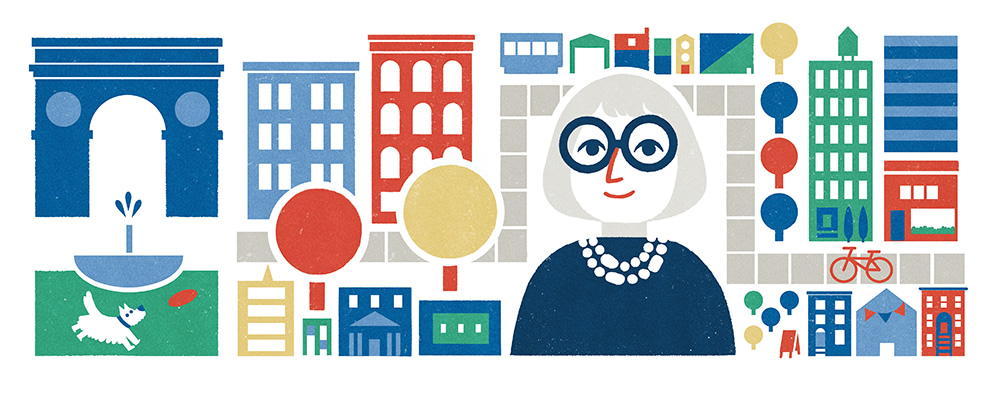
Jane Jacobs’ 100th birthday

Jane Jacobs’ 100th birthday

Happy Birthday Jane Jacobs!

“Why have cities not, long since, been identified, understood and treated as problems of organized complexity?”

Jane Jacobs was a self-taught journalist and community organizer that supported keeping the city of New York diverse in shape and function. She stood by beloved neighborhoods that were unjustly slated for “renewal” and revealed political biases in the permit process for new projects. In Jacob’s opinion, cities are for the people, and they’re safest when residents mingle on the street and in local businesses.

Jacobs developed her philosophy through living and interacting with the city itself, and described life on the city streets as a kind of social ballet. Her book, The Death and Life of Great American Cities (1961) still sits in the American Library of Congress.

Google

Logo systems: the future of logo design?

Technology has changed the landscape of the design industry drastically over the past 30 years, but the theory and approach to logo design has remained somewhat the same, with most designers (thankfully) using tried and tested principles that work.

Trends come and go, but with the growth of smartphone use there’s been a shift in the approach to how logos have been designed. This will certainly influence how designers think about brand identity design from now on.

The topic I want to discuss now is logo systems, which are on the upswing due to the opportunities they offer brands and individuals.

What is a logo system?

Historically a logo has always been a static object that was designed once and applied to all brand touch points. Different lockups may be designed for specific instances, but consistency was always a paramount focus to aid recognition. Prior to digital technology, logos and brand identities were only applied to physical objects, meaning change was not an easy or cheap option. This situation is a thing of the past…

Today, thanks to technology the most commonly seen instance of a logo is within an email signature, on a website, or on social media channels. Because these instances are digital they can be changed instantly.  This has unlocked opportunities for designers and marketers, with logo systems being one of the most interesting developments I’ve seen so far.

Instead of having a singular static mark, a logo system acts as a ‘graphical framework’ that can shift and change for different situations, allowing brands to start a conversation beyond it’s own name, pointing to other ideas and issues that are important to them on any chosen day.

Logo systems are somewhat of an evolution of ‘flexible logos’ which have been around for some time. The first of its type was designed in 1973 for Belgium supermarket chain Priba, which used a series of changing backgrounds and textures. MTV and Tate Modern are other noteworthy examples. At the time this was somewhat experimental, and primarily a cosmetic feature, but now this concept has gone one step further evolving into a valuable communication tool for brands to speak to its audience in a unique way.

Lets look at a few noteworthy logo systems.

01. Google Doodles

Google doodles raise awareness of historical moments

The most famous example and dramatic use of a logo system here today is Google.

Every day Google replaces its logo with a ‘Google Doodle’, an illustration, animation or game that’s been designed to raise awareness of a specific topic or historical event every day of the year. This extends globally, showing differently around the world. By using a framework to design the doodles, even when dramatic changes have been made it remains familiar to us as the Google logo.

By using its logo in this way, Google is able to educate the world about important topics, and be seen as an authority on the worlds information. They are able to do this with the logo alone, without adding any additional marketing messages or images on its homepage.

02. The Hillary Clinton Logo

A simple framework that draws attention to political issues

When the new logo for Hillary Clinton was released in 2015 it was mocked by many for its simplicity. Little did we know at the time of that it would act as an identifiable window to raise awareness of political issues and events.

It’s a logo that can be drawn quickly by anyone, whilst offering endless opportunity to communicate bold statements. Even when big changes have been made, due to the simplicity of the underlying framework it remains very recognizable.

03. The shifting ZocDoc face

A logo that helps to communicate associated emotion

As a digital health marketplace ZocDoc introduced a fun, customer friendly logo that looks like a face. To add additional meaning to it’s products and services the logo changes its facial expressions to suit the situation.

Although the logo appears differently across all touch points, due to its abstract and minimal form the logo remains very recognisable.

04. DC Comics

An adaptable framework that reveals the character behind the story

Once a platform that was only in print, comic books have boomed, now being seen on the big screen and in digital form. DC Comics took the opportunity by creating a logo system that would allow it to adapt its logo towards the story it was telling. With only a glance of the logo you know that character it’s been designed for.

Reality check: Are logo systems sustainable?

Due to the amount of design time needed to create variation, the concept of an ever-changing logo is not sustainable for some businesses. To be reactive to current events also requires speed. Due to this I do expect this approach to be used primarily by bigger companies with bigger budgets. That being said logo systems are still in their infancy, and I feel there is a lot of room for experimentation.

The smartphone world we live in has opened doors for unique opportunities for designers around the world, and I look forward to seeing what happens over the next few years. Things have only just started, so it’s an exciting time to be a designer.

Ian Paget

A strong brand identity

Build a visually strong brand identity with the help of this invaluable infographic.

Branding infographic

Giving your company a distinctive brand image is more than just using a logo design or slogan here and there, it’s all about creating an identity that consumers interact with.

To guide creatives through the challenge of building a brand, Creative Market have released this infographic which shares the basic steps you need to follow. From building a mood board of visual references to monitoring your brand’s success, this overview covers it all.

Topped off with further reading to help you take your branding to the next level once you’ve mastered the basics, this is one of the best infographics for those looking to get the hang of branding, as well as seasoned pros gearing up for a big rebranding project.

Dom Carter